

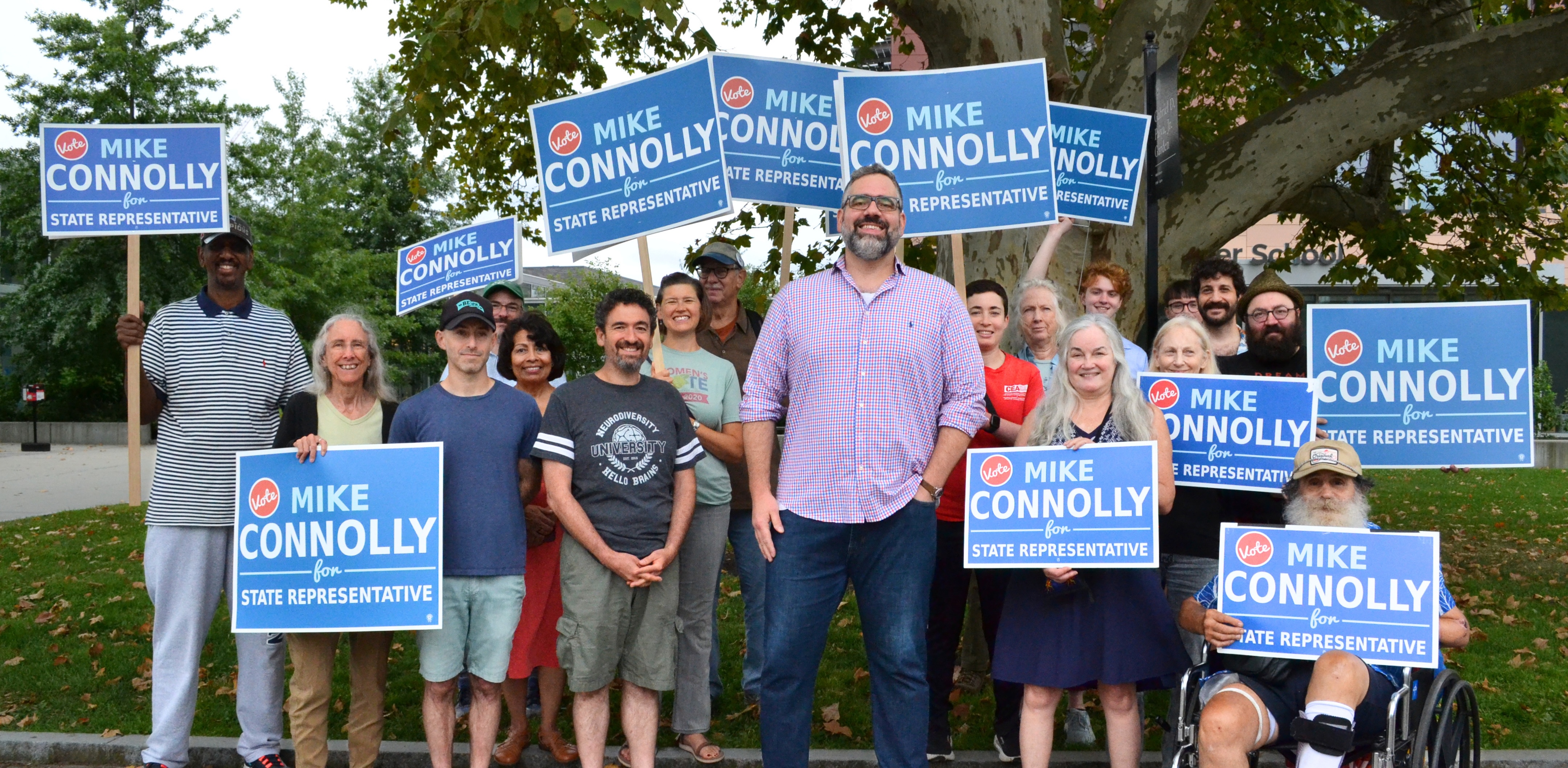
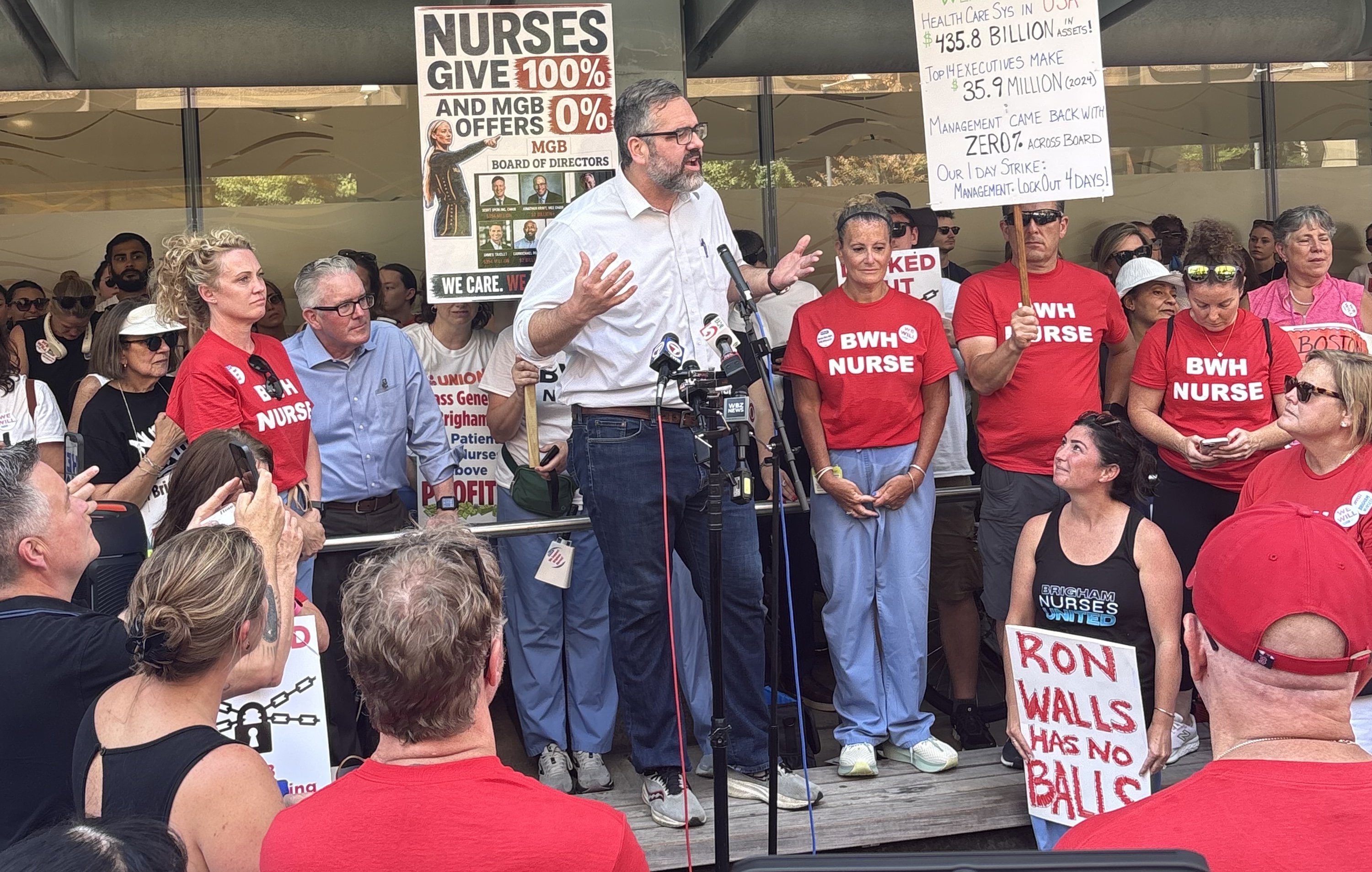
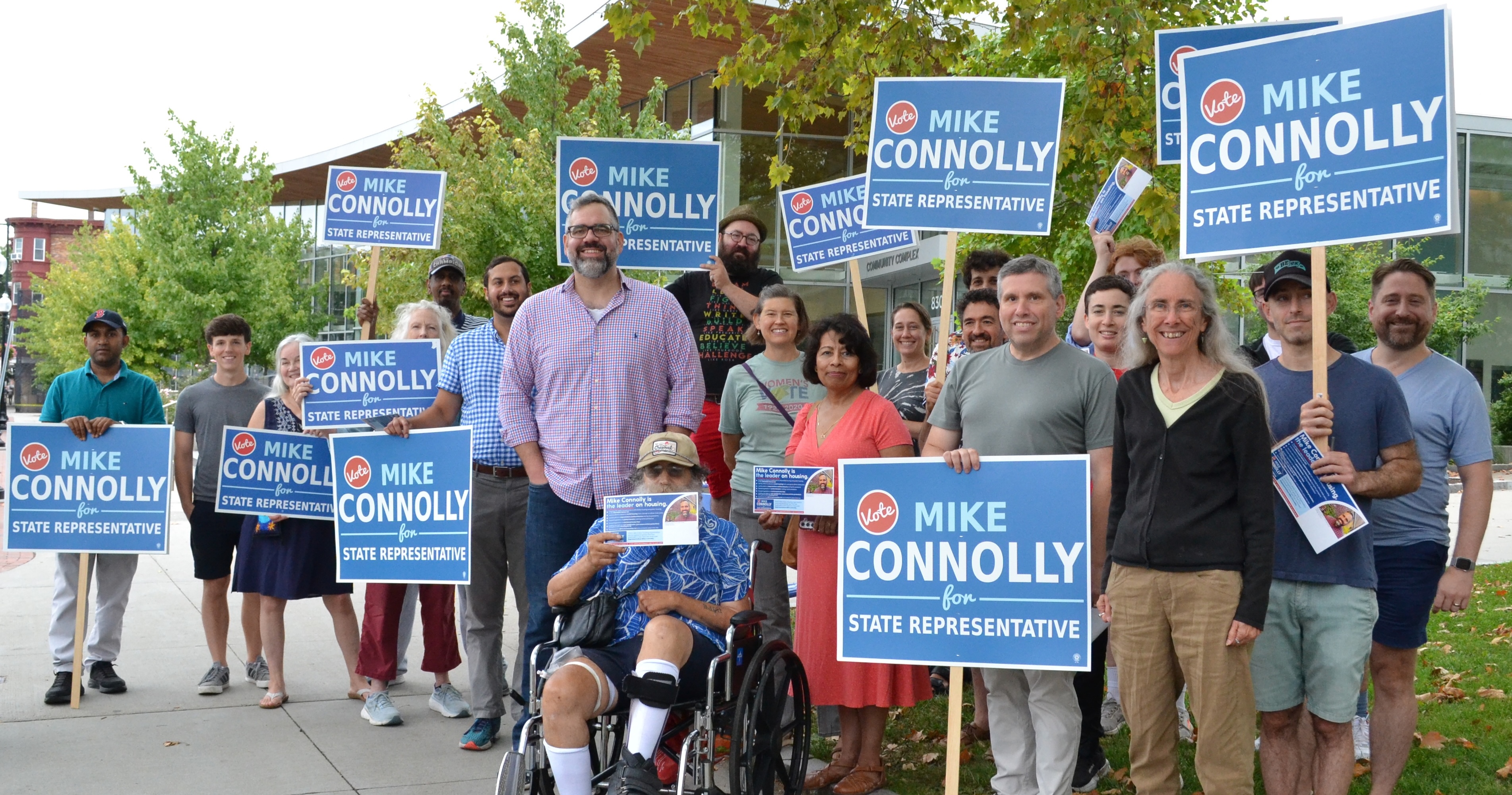
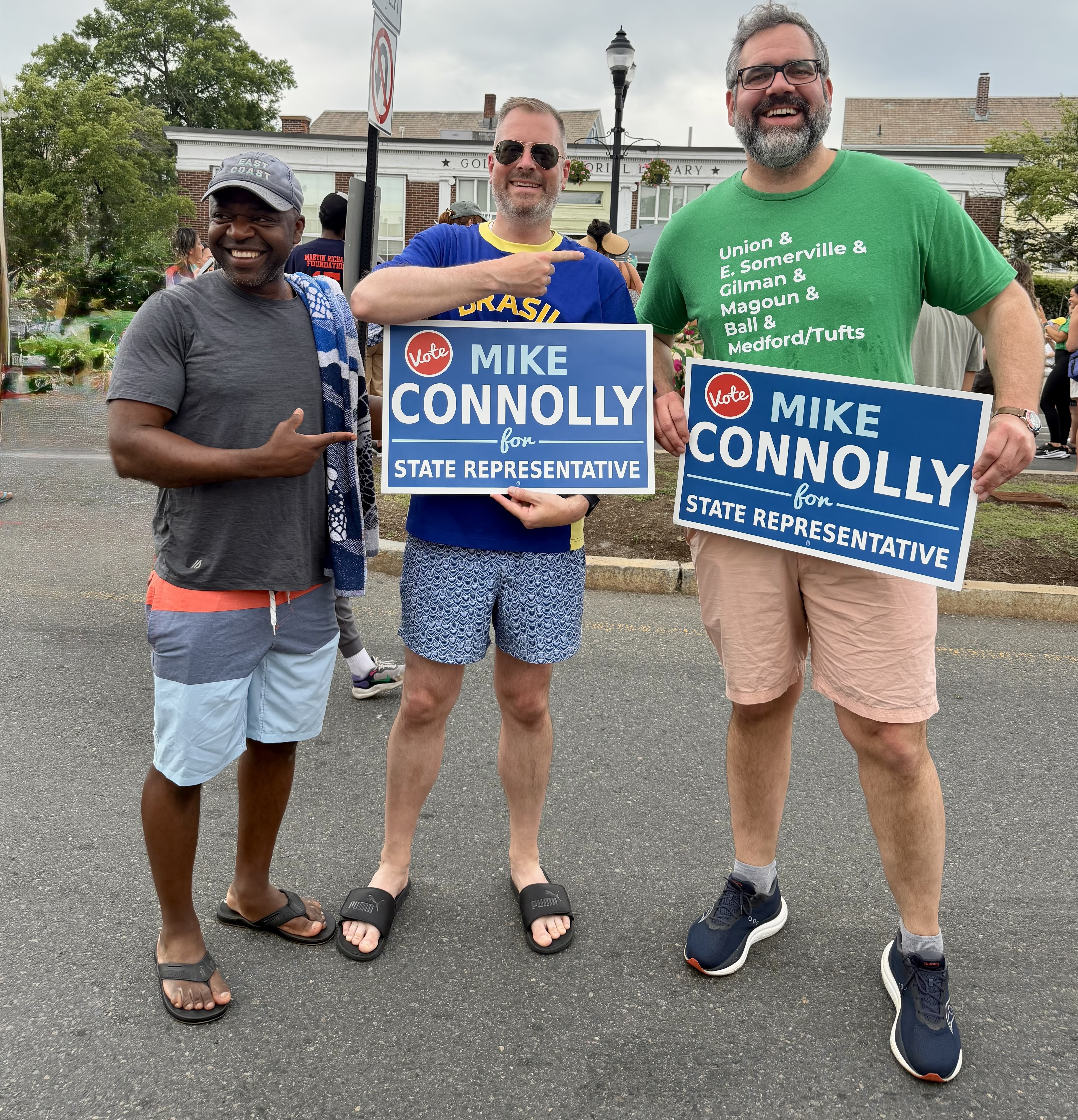


Hi. My name is Mike Connolly. I fight for our progressive values and pass legislation that delivers results.
Thank you for taking a moment to visit my website — and thank you as well for allowing me the honor of serving as your State Representative in the Massachusetts House of Representatives. Every day, I work to bring constituents, colleagues, and advocates together to make progress for all who live in our Cambridge and Somerville community. I'm proud of what we've accomplished together so far, but there's still so much more work to do. That's why I'm running for re-election in the Democratic primary on Tuesday, September 1.
As your State Rep., here’s what I’m most focused on:
-
Housing and affordability. I am recognized as a leader in the fight to resolve the affordability emergency, including the cost of housing, health care, child care, utilities, fees, and groceries.
-
Defending our community from the Trump agenda. I have been on the front lines of the fight to protect our immigrant neighbors and defend everyone’s constitutional rights. I have also passed legislation to expand abortion access and defend reproductive freedom, LGBTQ+ rights, gender-affirming care, and data privacy.
-
Making state government work for my constituents. My staff and I work tirelessly to help our constituents with state-related issues, from the Department of Unemployment Assistance (DUA) to MassHealth and various licensing boards. I have also successfully pushed for big investments and improvements to state infrastructure, from the MBTA to MassDOT and DCR roads, parks, and facilities.
In my five terms in office, I have consistently been ranked as having the most progressive voting record in the Massachusetts House by Progressive Massachusetts, the state’s leading grassroots advocacy group. At the same time, I have delivered real results by passing groundbreaking legislation to better protect tenants and homeowners, improve transit infrastructure, reduce our dependence on fossil fuels, and make the political process more accessible. That's why I have earned every major organizational endorsement in my campaign for re-election.
My background and what drives me
The reason I am so passionate about these and so many other issues stems from my background. I was born in Dorchester in 1980. My father was the son of Irish immigrants — he served in the Coast Guard and worked as a union machinist. My mother’s family is Italian and Swedish — and she worked as a hairdresser and is a talented artist.
At age five, my parents separated and divorced, and my mother and I moved to a low-income public housing project in Norwood, Mass. Not long after the divorce, my mother experienced some serious mental health challenges, and I was sent to foster care while she recovered.
In retrospect, I think these events helped me develop a sense of empathy that forms the core of my interest in public service — at a young age, I came to understand what it means to be vulnerable, what it means to be afraid and alone in this world — and this understanding is what fuels my desire to help others who are in need.
Growing up, I had the benefit of many social programs. I attended a Head Start program where I had the opportunity to start learning how to read and write and work with numbers. I received free lunch in school. My mother and I received fuel assistance to keep our housing unit warm in the winter. I was able to attend summer camps because of charity and government programs. And on Saturday mornings, my mother and I would visit a food pantry at a local church and pick up canned goods and boxes of mac ‘n cheese, cereal, and pasta.
I was able to overcome adversity only with the help of government programs, caring community members, and a loving extended family. I went on to attend Duke University on a football scholarship and earn a degree from Boston College Law School thanks to this support. But many of the kids I grew up with in the projects ended up incarcerated, on the streets, or victims of the opioid epidemic.
That is what drives me. I want to make sure that everyone in our community, no matter what challenges they face, is given at least the opportunities that I had. I became a licensed attorney and worked in the tech sector, but I found my passion as an activist and a community organizer. Then I worked as a legislative aide and ran for office because I know our government can and must do better.
Ten years ago, when the voters of our community first elected me to this seat, I distinctly remember how some Beacon Hill insiders told me I had to make a choice: go along to get along, or challenge House Leaders when they fall short and risk being marginalized. Frankly, I found that insulting. I vowed at that moment to reject that false choice. I believe our district wants a Rep. who will fight for our principles and get results — challenging the Speaker when necessary while working productively with colleagues to pass legislation and deliver for constituents. That is how I have approached this job from the beginning, and how I will continue to serve if honored with another term.
Accomplishments
Delivering the Green Line Extension and Community Path Extension. When I was elected in 2016, the Green Line Extension was in limbo, and Governor Baker was looking to scale back the project and eliminate the vital Community Path Extension. I worked alongside community advocates, local officials, and legislative colleagues to keep the project moving and restore key elements that had been put at risk, including the shared-use path for people walking and biking.
Passing the Fair Share Amendment, Improving the T, and Funding Education. I voted in the House to put the Fair Share Amendment on the ballot and campaigned for its passage in 2022, asking million-dollar earners to pay a little more to fund public transportation and education. Fair Share is now generating billions of dollars in new revenue, allowing us to make major investments in the MBTA, hire hundreds of new workers, improve service, and eliminate slow zones. Meanwhile, we passed the landmark Student Opportunity Act to increase funding for public schools, made universal free school meals permanent, expanded free community college and made higher education more affordable.
Increasing Investments in Affordable Housing and Public Housing. In my first term, as a member of the Housing Committee, I helped pass a $1.8 billion housing bond bill to invest in affordable and public housing. Last term, serving on both the Housing and Bonding Committees, I worked to pass the $5.2 billion Affordable Homes Act — the largest housing investment in state history, with billions of dollars for affordable and public housing and dozens of new policies to address our housing crisis. I also introduced legislation to establish a new model of permanently affordable, mixed-income social housing, and I successfully advocated for a social housing pilot program in the Affordable Homes Act.
Boosting Housing Production and Confronting Exclusionary Zoning. From my earliest days on the Housing Committee, I have pushed to end exclusionary zoning and remove barriers to building the homes we need. In my first term, I voted to advance the Housing Choice proposal and was one of just five legislators to co-sponsor an early version of the MBTA Communities Act. In my second term, I filed legislation to require multifamily zoning near transit and worked with colleagues to pass this concept into law. Last term, I worked to allow accessory dwelling units by right statewide, and most recently, I helped advance the YIMBY Act and streamlined site-plan review. These efforts have earned me the endorsement of pro-housing groups like Abundant Housing MA and Somerville YIMBY.
Passing Comprehensive Criminal Justice Reform Legislation. In my first term, I co-sponsored legislation to end mandatory minimum sentences for low-level drug-related offenses, and I worked with the House Progressive Caucus to reform bail, allow for compassionate release, expand restorative justice, and create alternatives to incarceration. These efforts culminated in the passage of major criminal justice reform legislation, and the results have been remarkable: overall crime is down, and over the past decade, the incarcerated population in Massachusetts has been cut by 45%.
Winning the Fight for $15 and Paid Family and Medical Leave. Prior to being elected, I worked with advocates who were fighting to win a $15 minimum wage, along with a robust Paid Family and Medical Leave program. In my first term, grassroots activists collected thousands of signatures to put both proposals before the legislature, and I was proud to help pass these two major economic justice initiatives into law. In 2023, the minimum wage reached $15/hour in Massachusetts.
My five terms in office have been marked by chaos at the federal level, and in the world: Trump, then the pandemic, and now Trump again. Some issues have needed attention for decades (from housing affordability and criminal justice reform to fixing the T) while urgent new threats have required an immediate response from our state government. I’m proud that we’ve made real progress on our longstanding goals while also responding to challenges exacerbated by the Trump Administration.
Defending Reproductive Freedom and Expanding Abortion Access. In my first term, I was proud to co-sponsor the ACCESS Act, guaranteeing access to birth control without copays. In my second term, I co-sponsored and helped pass the ROE Act, the biggest expansion of abortion rights in decades. In 2022, we passed the Reproductive and Gender-Affirming Care Shield Law, and last year, we updated the shield law, further protecting providers and patient privacy. Most recently, I co-sponsored and voted to pass An Act Prioritizing Patient Access to Care. This is why I have been endorsed by the Planned Parenthood Advocacy Fund of Massachusetts and Reproductive Equity Now.
Passing the PROTECT Act to Defend Our Immigrant Neighbors. For years, I have been on the front lines of the fight to better protect immigrants and defend everyone’s constitutional rights. In response to the Trump administration’s ICE crackdown, I worked closely with immigrant-rights advocates and the Black and Latino Legislative Caucus to co-sponsor and pass the PROTECT Act. This new law prohibits state and local law enforcement from acting as ICE agents through 287(g) task-force agreements, limits the use of state resources for civil immigration enforcement, and strengthens protections in courthouses, schools, hospitals, and other sensitive locations.
Establishing Police Accountability. In the wake of the murder of George Floyd, I worked with the Black and Latino Legislative Caucus and progressive colleagues to pass landmark police reform legislation establishing statewide standards for law enforcement. We created the independent POST Commission with the power to suspend or revoke the certification of officers who engage in serious misconduct. We also banned chokeholds, limited no-knock warrants, established a duty to intervene when witnessing excessive force, and strengthened use-of-force and de-escalation requirements.
Passing the Nation’s Strongest Eviction and Foreclosure Moratorium. When the Covid-19 pandemic struck, I led the effort on Beacon Hill to protect tenants and homeowners, working with House Leaders and housing advocates to pass the nation’s strongest eviction and foreclosure moratorium. The law ensured housing stability during the worst of the pandemic and was credited with saving countless lives. In 2023, I worked to make a key provision of the moratorium permanent, pausing eviction cases while tenants await decisions on rental-assistance applications. This year, I used that provision to help a longtime constituent preserve housing for herself and her young daughter.
Standing up for our values on Beacon Hill
Defending the Voter-Approved Legislative Audit Law. Massachusetts voters overwhelmingly approved a 2024 ballot question empowering the State Auditor to audit the Legislature. When House leadership advanced legislation this spring to narrow the scope of that voter-approved law, I was one of only three House Democrats to vote No. While I think legitimate constitutional questions should ultimately be resolved by the courts, I did not believe the Legislature should pull the rug out from under the Auditor — and the voters — by rewriting the law before those questions were resolved.
Voting for Same-Day Voter Registration. In 2022, I was one of 61 House Democrats who voted to advance Same-Day Voter Registration, allowing eligible residents to register and vote on Election Day. That proposal was opposed by the Speaker and did not pass, but I have continued co-sponsoring Same-Day Registration bills because voting should be made more accessible — not more difficult. This fall, Same-Day Voter Registration will be a ballot question, and I am campaigning for a Yes vote.
Fighting to Tax the Rich and Big Corporations. I have consistently fought for a fairer, more progressive tax system so we can make the public investments our communities need. In 2023, I was one of just three House members to vote No on a $1+ billion annual tax-cut package that gave significant benefits to the very wealthy and big corporations. I argued on the House floor that we should only pass the parts of the bill that helped middle-class families, seniors, renters, and low-income workers, without including new tax breaks for the ultra-rich and big corporations.
Standing Up to Big Pharma and Fighting for Affordable Health Care. In 2019, when the pharmaceutical industry pushed House leaders to weaken what would have been Massachusetts’ first serious effort to control prescription drug prices, I was one of just three House members to vote against the industry-backed amendment. The proposal we were fighting to preserve would have given the state stronger tools to negotiate lower prices and hold drug manufacturers accountable. I have long been a member of the Medicare for All Caucus and a sponsor of Medicare for All legislation.
Voting Against Devastating Cuts to Mass Save. This year, I voted against the House energy bill because it proposed major cuts to Mass Save, our state's flagship energy-efficiency program. I strongly support making utility bills more affordable, but we cannot pit affordability against climate action by cutting programs that help residents use less energy and lower their bills over the long term. Instead, I have pushed to hold investor-owned utilities accountable and address the corporate profits and structural costs driving our utility bills upward. I am also the lead sponsor of legislation to transition to public ownership of our public utilities.
Voting for Data Privacy and Against Age-Gating the Internet. I strongly support protecting children from the harmful practices of Big Tech, but I do not believe we should accomplish that by requiring everyone to prove their age or identity just to use the Internet. That's why this year, I was one of only two House Democrats to vote against legislation containing broad age-verification requirements because of the serious implications for privacy, free expression, and data security. I continued working with civil-rights and LGBTQ+ advocates to oppose this approach; since then, the age-gating scheme has stalled, and the focus has shifted to regulating addictive features aimed at youth. More recently, I voted for strong consumer data-privacy legislation that takes direct aim at surveillance-driven business practices and the sale of sensitive personal information.
Stay Informed and Keep In Touch
I pride myself on being very accessible to my constituents. If you wish to discuss legislative matters or have any requests for constituent services, please contact my office at (617) 722-2230 or email me at [email protected]. Working closely with my staff and agency liaisons, our office has resolved countless constituent cases, from helping residents obtain health insurance via MassHealth, to requesting repairs on state-owned property, to assisting constituents who face difficulties in accessing government programs and services, including unemployment assistance.
I also welcome constituents to contact me directly. For campaign questions or urgent matters, you can always reach me on my personal cell phone at (857) 236-1901 or [email protected]. I love hearing from constituents, so please keep in touch. Your voice, your perspective, and your input as a constituent are what matter most to me as I do this job.
You can also follow me across social media via @MikeConnollyMA and read my State House blog or subscribe to my office newsletter via www.RepMikeConnolly.org.
I respectfully ask for your vote on or before Tuesday, September 1. The promises I made when I first won this seat are the same promises I pledge to keep today: I will never abandon our shared progressive values, I will always fight for those who most need policymakers to be on their side, and you will always be able to reach me directly with any questions or concerns you might have.
Yours in service,
Rep. Mike Connolly
-
Correcting the record: Neil Miller dishonest mailer
Correcting the record: Neil Miller dishonest mailer
Dear Cambridge and Somerville Constituents and Supporters —
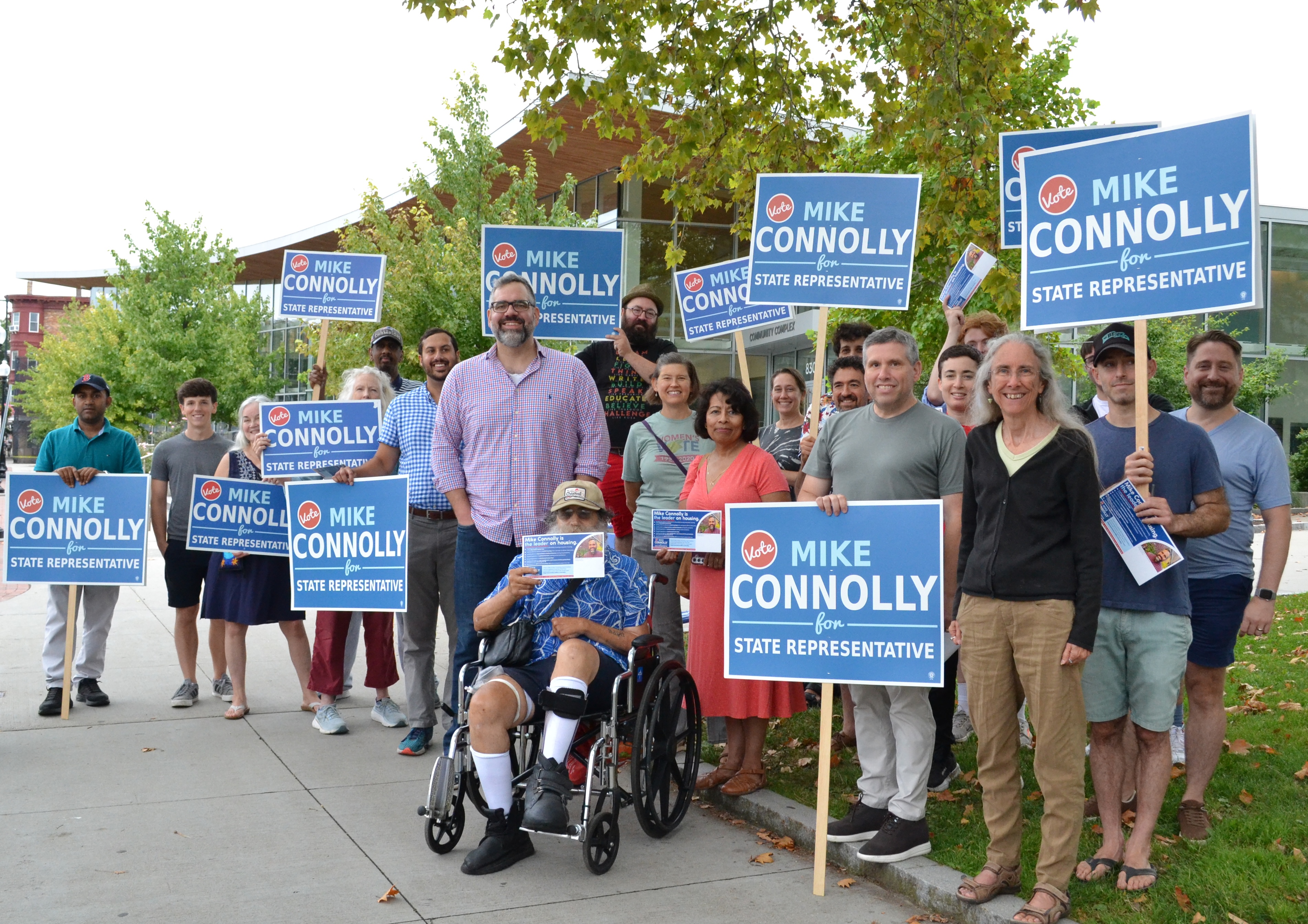
I was planning to write to you this evening about the incredible day we had celebrating the start of in-person early voting on Saturday. Thank you to Senators Sal DiDomenico and Lydia Edwards, Rep. Steve Owens, Councilor Jivan Sobrinho-Wheeler, and all of the friends and supporters who showed up throughout the day to stand with us.
However, this afternoon, the challenger in my race sent out a campaign mailer loaded with dishonest claims about my work on housing. This is especially concerning because thousands of Cambridge and Somerville voters are now being hit with this misinformation just five days before the Democratic primary on Tuesday, September 1.
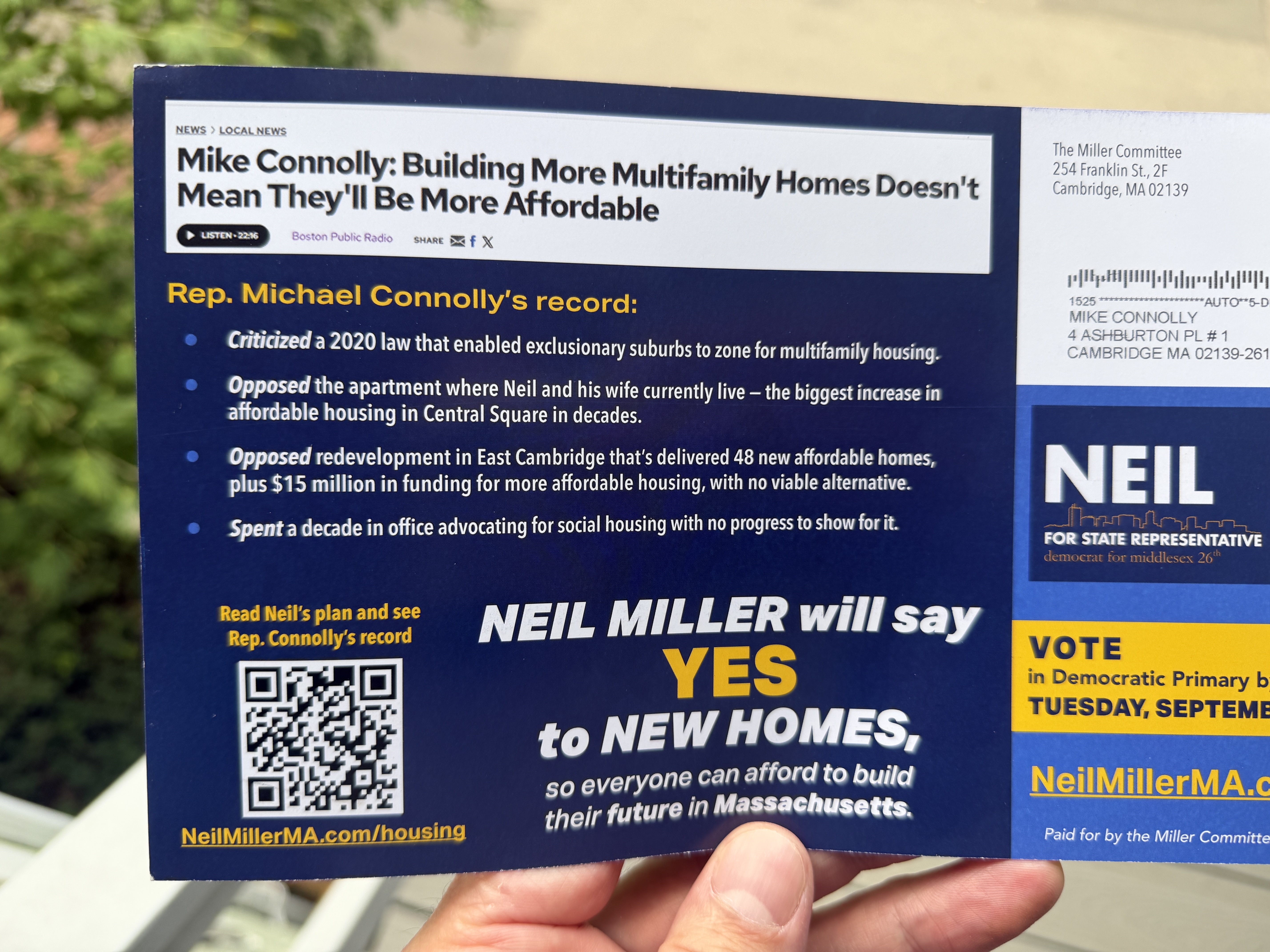
First, I want to walk you through the claims Neil Miller is making and explain why they are dishonest. Then, I am going to ask for your help so we can finish the race strong.
MBTA Communities Act
Mr. Miller says I "criticized a 2020 law that enabled exclusionary suburbs to zone for more multifamily housing" — that's a distortion of what I was actually doing.
The fact is, I sponsored and co-sponsored versions of the MBTA Communities Act and voted to pass the final version into law. My main criticism was that I thought the legislature should pass other key housing policies along with it, such as a local option for rent stabilization and more options for affordable housing.
He uses the headline from this 2020 WGBH article to try to prove a point — but as the article itself makes clear, I agreed with the premise of the MBTA Communities Act and was pushing the legislature to be even more ambitious with tenant protections and investments in affordability. That is the kind of comprehensive response to the housing emergency that I believe Cambridge and Somerville residents want, so it's disappointing that Mr. Miller would dishonestly portray my actual stance.
Market Central
Mr. Miller then says I "opposed" the building where he and his wife currently live — Market Central, the 19-story housing tower in Central Square, where a two-bedroom apartment currently rents for $5,572 a month.
Eleven years ago, when the Cambridge City Council considered spot-zoning for this building, I was an aide inside City Hall, working with city councilors on a proposal for a public-private partnership at this site. Our proposal would have resulted in significantly more housing and more affordable housing than what we ultimately got in the Market Central deal, because it would have allowed the developer to build housing on top of city-owned Parking Lot #6 in exchange for even more affordable units.
So it's disingenuous to claim, all these years later, that I opposed housing at the site. I was deeply involved in fighting for more housing and more affordable housing where this building now stands.
Sullivan Courthouse redevelopment
Next, Mr. Miller says I "opposed" the redevelopment of Sullivan Courthouse in East Cambridge that delivered 48 new affordable units. This might be the most dishonest claim of all — because the record shows it was my original idea, and the grassroots efforts I led, that gave the city council the leverage to secure those affordable units.
In October 2018, I stood up in an obscure public meeting and offered my theory — that the city council could use the developer's need to obtain a parking approval to win affordable housing. Then I organized a grassroots campaign and hundreds of residents joined the fight. Ultimately, Cambridge Day declared that I "led the housing fight" that resulted in these 48 affordable homes.
Social Housing
Finally, Mr. Miller says I "spent a decade in office advocating for social housing with no progress to show for it." Again, this is false on multiple levels.
I introduced the first-ever social housing bill on Beacon Hill in the summer of 2023. That's three years ago. I worked with Secretary Augustus and legislative colleagues to include a funding authorization for a social housing pilot in the Affordable Homes Act. Then, in August 2024, Governor Healey invited me to the signing of the Affordable Homes Act, which passed this social housing concept into law. Last year, the Healey-Driscoll Administration released its housing plan, which incorporates social housing as part of our official state policy.
Also last year, I worked with the Healey-Driscoll Administration to create a state-level social housing working group. We decided social housing can't just be a top-down model — it has to be informed by local communities. Now, I'm part of Cambridge's Social Housing Task Force, where we are bringing city leaders, staff from the state's Executive Office of Housing and Livable Communities, local advocates, housing professionals, and residents together to determine how Cambridge can take advantage of the state's new social housing opportunities and develop a program of our own. Meanwhile, Mayor Wilson has committed the City of Somerville to pursuing this opportunity as well.
As housing advocate Jesse Kanson-Benanav said in this recent letter endorsing my campaign, "Going from a new policy concept to an official part of the commonwealth’s housing strategy in a single legislative term is almost unheard of." That's part of the reason why he called me a "housing champion" for Cambridge and Somerville.
Your Help Needed
In closing, I need to ask for your help. Mr. Miller's dishonest claims are disrespectful to the voters, and our community deserves better. But we all know that misinformation can lead to unpredictable results at the ballot box.
So if you care as much about good housing policy as I do, and if you appreciate my work for our community, then I ask you to make a contribution to my re-election campaign. Click here to donate.
My field team and I will be canvassing and phone banking over the next five days, and we need your help holding signs on Election Day, too.
To get involved, sign up on my volunteer page, or simply reply to this email to let us know when we can plug you in.
I am so grateful to everyone who has gone out of their way to support my re-election campaign this year. But I have to respectfully ask for more help right now. My campaign is doing everything we can to get the truth about my record out there, but we need additional resources and all hands on deck.
Thank you, as always, for being a friend and a supporter.
Yours in service,
Mike

-
Join us Saturday to celebrate the start of in-person early voting
Join us Saturday to celebrate the start of in-person early voting
Dear Cambridge and Somerville Friends and Constituents —
Thank you to everyone working in support of my re-election campaign. Vote by mail is in full swing, and in-person early voting starts this Saturday!
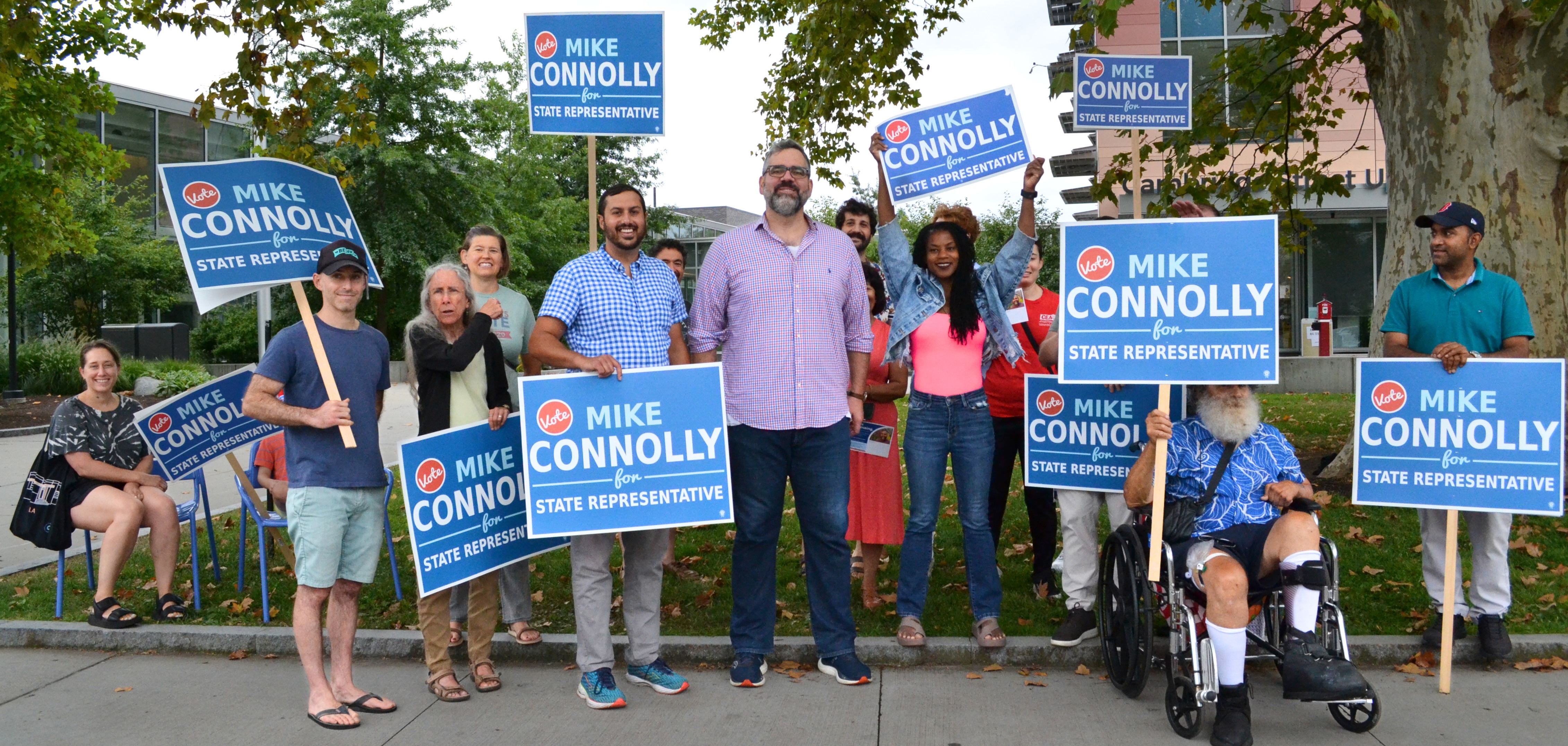
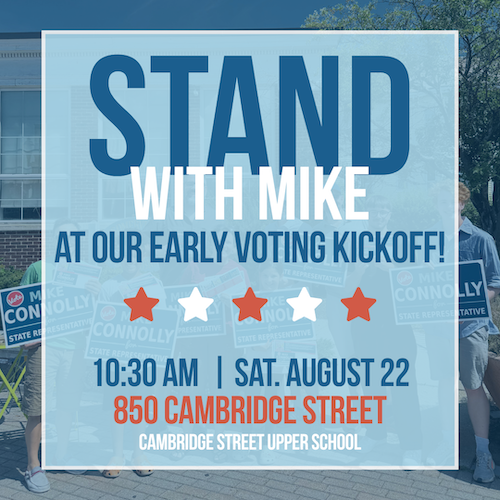
I want to invite you to join me and my team to celebrate the start of in-person early voting. We will gather in front of the Cambridge Street Upper School at 10:30 am Saturday for a photo. 850 Cambridge St., Cambridge.
Come by to say hello, pick up a yard sign or a window sign, sign up for a volunteer shift — and most importantly, walk around the corner to the Valente Library (Berkshire Street entrance) to cast your vote in the state primary.
To let us know you're coming, check the box on my volunteer page.
Complete information for early voting in Cambridge is available here.
And information about early voting in Somerville is available here.
I'm proud of all the support we've received so far — every organization and local group that has endorsed in this race has endorsed my campaign — that's more than 30 organizations focused on housing, transit, education, reproductive freedom, LGBTQ+ rights, immigrant protections, economic justice, human rights, and more.
And the most important endorsement of all comes from you.
I am not taking anything for granted. We're out there every day competing for every vote, and I need your help to emerge victorious on September 1.
I hope to see you Saturday morning at 10:30. Thank you, once again, for being a friend and a supporter.
Yours in service,
Mike

-
Every major organization that has endorsed in this race has endorsed Mike
Every major organization that has endorsed in this race has endorsed Mike
Every major organization that has endorsed in the 26th Middlesex has endorsed Rep. Mike Connolly.
Whether a voter’s top concern is housing affordability, reproductive health care, LGBTQ+ rights, climate change, workers’ rights, public education, or transportation, the people fighting for these issues are united behind State Representative Mike Connolly in his campaign for re-election in the 26th Middlesex.
Rep. Mike Connolly has earned the trust and support of every major organization endorsing in the race, both locally and across the state. The coalition backing Connolly includes over 30 organizations, representing thousands of organizers and activists fighting on the front lines and working on the most pressing issues facing our state.
Here’s what the state’s leading progressive advocacy organization has to say about Mike:
“Mike Connolly has been a progressive champion since we first endorsed him in 2016,” said Jonathan Cohn, Policy Director at Progressive Massachusetts. “Mike is the rare state representative who gets an ‘A’ every year on our Progressive Scorecard. Mike has fought for stronger tenant protections, social housing, and revenue for affordable housing, as well as workers’ rights, bold climate action, voting rights, transparency, and more. Mike is willing to speak out against bad, rushed legislation and to push the State House to be more ambitious in all of its policymaking.”
Advocates working to address the housing emergency are also with Mike.
“Representative Connolly has consistently championed reforms that expand housing production while strengthening tenant protections. He has actively sponsored and co-sponsored pro-housing legislation and used his position in the State House to help turn those policies into law — from legalizing ADUs by right statewide and unlocking more housing production around transit, to pioneering the concept of mixed-income social housing in Massachusetts. The cities of Cambridge and Somerville have a real housing champion in Mike Connolly,” said Jesse Kanson-Benanav, Executive Director of Abundant Housing MA.
As Trump continues to wage war on reproductive freedom, organizers at the center of the fight to protect abortion rights are with Mike.
“For years, Mike has been a true partner to Planned Parenthood at the State House, championing health care access for all and fiercely advocating for reproductive rights legislation including bills to remove abortion restrictions in Massachusetts,” said Dominique Lee, President of the Planned Parenthood Advocacy Fund of Massachusetts. “In the year and a half since Trump took office, attempts to curtail Planned Parenthood’s services and threaten reproductive health providers have skyrocketed, but at every turn, we’ve had leaders like Representative Connolly taking action to invest in reproductive health care and ensure Massachusetts leads the way for reproductive freedom. The Planned Parenthood Advocacy Fund is proud to endorse Mike Connolly for re-election.”
Environmental groups across the state have also backed Connolly as the climate candidate for Cambridge and Somerville.
“Mike Connolly has been a champion for energy efficiency, renewable power, expanding clean air and water regulations, and community engagement,” said Casey Bowers, Executive Director of the Environmental League of Massachusetts Action Fund. “He has demonstrated true leadership for the 26th Middlesex District, including for environmental justice communities like East Somerville, the Port, and Cambridgeport. The ELM Action Fund is thrilled to endorse his candidacy.”
“Mike will continue to fight for climate justice and energy affordability, and he knows we can’t pit the two against each other,” said Vick Mohanka, Chapter Director of the Sierra Club Massachusetts. “Our chapter is proud to endorse Mike for reelection in his fight to hold investor-owned corporate utilities and the fossil fuel industry accountable.”
The message from Massachusetts progressives is resoundingly clear: they want Mike Connolly to continue the fight alongside them in the State House.
“I am honored that so many labor unions, progressive organizations, and local groups have recognized my accomplishments in the legislature and my commitment to justice in all its forms,” said Rep. Mike Connolly. “From teachers and housing advocates to nurses and climate activists, these are the organizers who know what it takes to deliver on our values on Beacon Hill. These organizations do not offer their support lightly. In some cases, I am the only incumbent, or one of just a few, to receive their endorsement. I am grateful and proud to have earned their support through years of standing together, fighting for our shared values, and delivering results.”
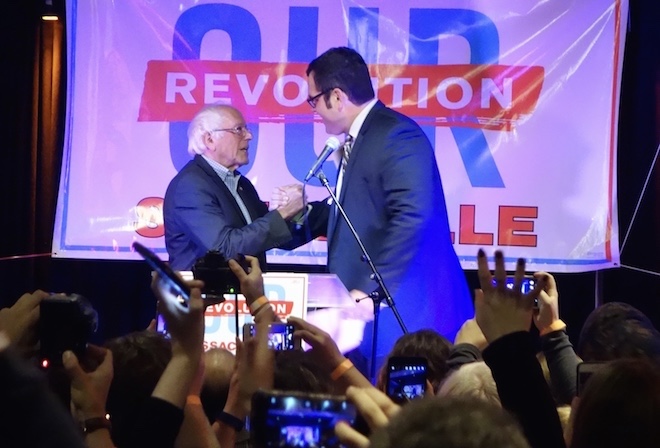
Rep. Connolly has also been endorsed by Reproductive Equity Now, MassEquality, Massachusetts AFL-CIO, Massachusetts Teachers Association, Massachusetts Nurses Association, National Association of Social Workers (Mass. PACE), Service Employees International Union State Council, UNITE HERE Local 26, Transportation Division of the International Association of Sheet Metal, Air, Rail and Transportation Workers, Massachusetts Organization of State Engineers and Scientists, Massachusetts Voters for Animals, Our Revolution Cambridge, Cambridge Bike Safety, Somerville YIMBY, Somerville for Palestine, and dozens of other groups and elected officials. For a full list of endorsements, please visit www.mikeconnolly.org/endorsements
-
A Specific Example of the Differences on Housing Policy in This Race
A Specific Example of the Differences on Housing Policy in This Race
Dear Cambridge and Somerville Constituents —
Last week I reached out to ask for your help in my re-election campaign — and so many of you responded with pledges to vote, sign requests, donations, and commitments to volunteer—thank you!
If you still want to get involved, you can visit my volunteer page to sign up to contact voters or request a sign, and you can make a contribution here.
On Thursday, I participated in a forum with my opponent, Neil Miller, and he continued to present a distorted case for why he would be a better leader on the issue of housing.
He once again criticized a vote I cast in 2023, and I want to take a moment to talk about it, because I think it's actually a good example of the kind of leadership I provide on housing, and some of the differences in this race.
My vote was in opposition to a major expansion of the state's Housing Development Incentive Program, also known as HDIP.
Housing development incentives sound good, right?
The problem with HDIP, as I explained in my speech on the House floor, is that every year it gives tens of millions of dollars to for-profit, market-rate housing developers, but it has no affordability requirements whatsoever.
Moreover, the program offers no direct benefit to Cambridge or Somerville, because the funding only goes to designated Gateway Cities. And even the term "gateway city" can be problematic, because the needs of Salem and Quincy are different from those of Pittsfield or Chelsea.
Many noted leaders in Gateway Cities, such as Chelsea's Gladys Vega, have called for affordability reforms to HDIP. So have the leaders of Progressive Massachusetts and the Massachusetts Association of Community Development Corporations.
A report from the Massachusetts Law Reform Institute (MLRI) documented some of the results of the HDIP program: a state-subsidized studio in Malden renting for $3,438/mo.; a one-bedroom in Lowell renting for $3,467/mo.; and literally the first-ever million-dollar condo sold in Salem.
According to the latest data compiled by MLRI, the state has provided some $146 million in HDIP credits to 88 residential developments, and the results have been stark: 97% of the units are market-rate or above; just 3% of the units are affordable.
To be sure, we all understand it is very difficult to build housing right now. And I support doing everything possible to do so. But as I explained at this week's forum, even when it comes to getting market-rate housing off the ground, there are much better ways to make it happen.
One example of a better way is a program I helped advance in the Affordable Homes Act called the Momentum Fund. The Momentum Fund is a revolving investment fund, administered by MassHousing, that helps market-rate projects get off the ground in this very difficult fiscal environment. The Momentum Fund requires that at least 20% of the new units be set aside as affordable.
And best of all, the fund is designed to revolve, so the Commonwealth's investment can be returned and reinvested in additional housing over time — unlike HDIP, which basically hands no-strings-attached state dollars to high-end housing developers. The Momentum Fund is one of the ideas that emerged, in part, out of my advocacy on Beacon Hill to advance the concept of social housing.
Even when I voted No on HDIP, I said that I would be willing to come to the table and work with those who support HDIP if we can build some equity into the program. But as I said in my floor speech, when my constituents are begging the state legislature to pass a local option for rent stabilization, when we've been working for years to pass a local option real estate transfer fee to tax high-end transactions and fund local affordable housing efforts — I could not in good conscience vote for HDIP.
This is important, so I invite you to watch my five-minute speech on this topic from the House floor. I posted it to my YouTube.
Right now, my opponent is going door-to-door, telling voters I have opposed housing. But that is a ridiculous claim. At our forum, I had to remind him that leading pro-housing groups like Abundant Housing MA and Somerville YIMBY have endorsed my campaign.
Mr. Miller keep telling voters that I “voted against funding for gateway cities to add new homes to their downtown” and “voted against funding for housing in working-class cities.” I hope my explanation helps put this vote in context. I believe the residents of our community want a State Representative who will look at how state dollars are spent through an equity lens, and work to ensure that state programs are designed to have the greatest public benefit.
Mr. Miller is also criticizing my support for the deal that brought TransMedics to Assembly Row. TransMedics makes devices that transport lungs, hearts, and livers for transplantation, saving lives. That deal bringing this company to the 26th Middlesex includes $18 million in state tax breaks and $18 million in city tax breaks. What makes this combined deal good is that it comes with real requirements for 900 jobs and millions of dollars in investment in Somerville. Progress is assessed annually, and if the company fails to deliver, both the state and the city can claw back those incentives. That’s the key difference between the TransMedics deal and the HDIP program: this public investment comes with enforceable requirements, clawbacks, and accountability, while HDIP has no affordability requirement whatsoever. Moreover, the TransMedics deal was approved on a 10-0 vote by the Somerville City Council in October 2025.
I could spend all day writing to you about some of the other dishonest claims that have been made in this race, or why I have every major organizational endorsement in my campaign. But I should probably get out there and keep knocking doors myself.
If you value the kind of leadership I bring to the State House, on housing and on so many other issues, I respectfully ask for your support in whatever ways are possible right now and over the next two weeks.
Thank you, once again, for being an informed constituent.
Yours in service,
Mike